
Keywords
coup d'état
Abstract
Milestone anniversaries tend to crystallize images of the past while also revealing how much the questions through which we interrogate it have changed. Sixty years after the 1966 coup d’état and fifty years after that of 1976, the cycle of radicalization, political crisis, repression, and dictatorship that Argentina experienced during the 1960s and 1970s remains one of the most active fields of historical research. In recent decades, the history of the left and the field of recent history have broadened both their objects of study and their source bases: alongside revolutionary organizations and state violence, renewed attention has been paid to the radicalization of the intellectual field, the right, anticommunism, political cultures, political languages, and the different forms assumed by the state of exception. This shift makes archives capable of bringing into relation materials originally produced by opposing actors especially important. Founded around the preservation of left-wing culture, CeDInCI has also become a privileged site for reconstructing these conflicts, tracing the left’s adversaries and interlocutors, and studying the political and cultural networks within which these different actors operated.
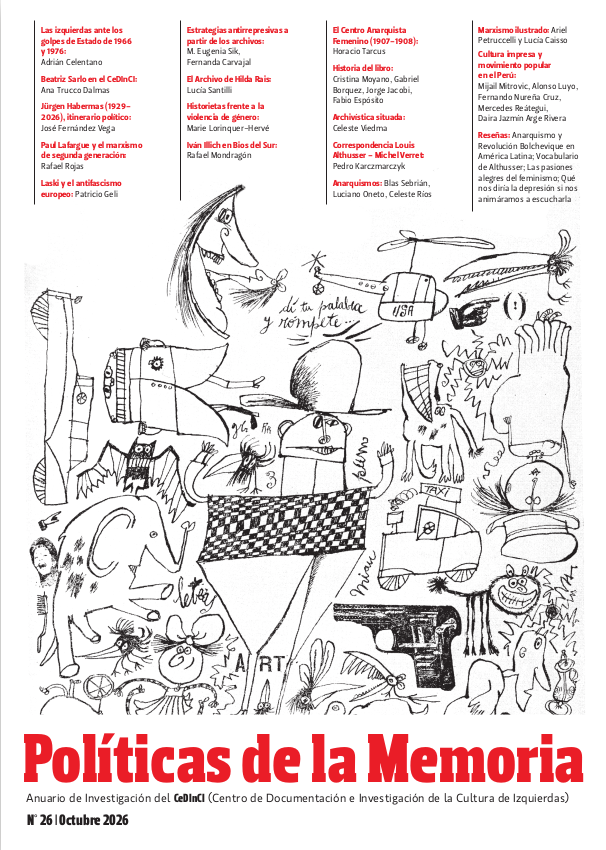
Between March and July 2026, CeDInCI hosted a documentary exhibition featuring newspapers, pamphlets, posters, leaflets, films, reports, cartoons, and comic strips published by the Argentine left, with the aim of documenting its positions in the lead-up to the military coups of 1966 and 1976. Without overlooking the left’s blind spots and internal disagreements, the exhibition sought to challenge contemporary right-wing attempts to absolve the Armed Forces, political parties, and the dominant classes of responsibility for their appeals to the state of exception.
The half-century that separates us from the 1976 coup and the sixty years since the coup of 1966 have done little to diminish the intense scrutiny of those conjunctures. They were political conjunctures: moments in which transformations in the balance of social and cultural forces affected the entire Argentine political equation. They were also conjunctures in which the state of exception operated in shifting, intermittent, or increasingly expansive forms until the military coup imposed a dictatorial form on the capitalist state.
The challenge of the 1960s was to break the deadlock of social confrontation, and the left opposed the coup, denouncing its antidemocratic and repressive character. In 1966, the upper echelons of the Church, the trade-union movement, and the business sector supported General Onganía’s coup, while Perón called on his followers to “dismount until the skies clear.” The exhibition corpus ranged from the traditional left, represented by Nuestra Palabra—the newspaper of the Argentine Communist Party (PCA)—and the socialist La Vanguardia, to the emerging New Left represented by Socialismo de Vanguardia, a splinter group of the socialist left; La Verdad, the organ of the Trotskyist and Indo-Americanist Revolutionary Workers’ Party (PRT); and No Transar, published by the Maoist Vanguardia Comunista (VC). Peronism, which had been proscribed since the 1955 coup, was represented through a series of pamphlets and leaflets produced by its combative sectors, which associated their ideas, intellectual figures, and militants with the political language radiating from the Cuban Revolution. Alongside a cover of Primera Plana supporting General Onganía, we also displayed the unpublished issue of Tía Vicenta in which Landrú ridiculed the military officer who led the traditionalist coup.
The cultural magazines included in the exhibition denounced the barbarism of the coup. These ranged from El Escarabajo de Oro and La Rosa Blindada—which championed, respectively, committed and revolutionary links between politics and Latin American culture—to Cristianismo y Revolución, associated with the Movement of Priests for the Third World and linked to the combative Peronism of the CGT de los Argentinos. The journals of the intellectual New Left placed the Argentine military uprising within a broader sequence of military interventions that included the Brazilian coup, the U.S. invasion of Santo Domingo, and the Vietnam War. Their covers foregrounded the figure of the Third World combatant over that of the suffering victim that had predominated during the first decades of the Cold War.
Once in power, the Armed Forces expanded the network of exceptional legal instruments and introduced clandestine practices of abduction and torture, first to repress the social protests that began in 1969 with the Cordobazo and Rosariazo uprisings, and subsequently to confront the growing activity of Montoneros and the People’s Revolutionary Army (ERP), the country’s two principal armed organizations. In 1973, however, the military was forced to permit the first democratic elections in which Perón and his movement were allowed to participate, and they emerged victorious.
Until 1973, successive forms of the state of exception had guaranteed the political exclusion of Peronism. Once in power, however, Peronism itself increasingly resorted to the state of exception in an attempt to resolve both social conflict and the internal confrontation between its leader and the revolutionary tendency within the movement. Perón and his wife, “Isabel,” forged an alliance with the traditional trade-union leadership of the CGT, consolidated the Social Pact promoted by Economy Minister José Ber Gelbard, and expanded the political power of the far-right minister José López Rega. Alongside a photograph of Isabel posing before a table overflowing with portraits of Evita, we displayed leaflets produced by Peronist trade-union organizations affirming a political continuity between the leader’s two wives.
Several documents in the exhibition recover the rejection by Montoneros and other armed left-wing organizations of a government they accused of failing to fulfill its popular and socialist promises. These include the mass-circulation legal newspapers Noticias and El Mundo, as well as the magazines El Descamisado, El Peronista, and Militancia, all of which were shut down during the first months of 1974. We also exhibited earlier denunciations of the “counterrevolutionary” role of the Justicialist leader published in El Combatiente, the clandestine organ of the PRT, and Estrella Roja, the ERP’s newspaper.
Perón died in July 1974. Shortly before his death, he had introduced changes to the legal order that constituted new forms of the state of exception. These were accompanied by federal interventions in provincial governments elected in 1973 and led by figures associated with the Peronist left. The state’s renewed construction of the internal enemy—the so-called “subversive”—coincided with the emergence of the parapolice organization known as the Argentine Anticommunist Alliance (AAA). The AAA was responsible for murders openly celebrated in the magazine El Caudillo, threats against artists such as Mercedes Sosa, and posters targeting Marxists, whom it branded “homosexuals and drug addicts” for opposing police chief Osinde. Meanwhile, cultural magazines associated with left-wing groups, such as Crisis and Los Libros, continued to appear; others, such as Nuevo Hombre, attempted to do so but were shut down, while some, including Somos, the publication of the Homosexual Liberation Front, ceased circulation.
From late 1974 onward, Isabel retained the support of important sectors of the Justicialist Party and the leadership of the CGT. In opposition to them, the left supported workers’ struggles amid state interventions in class-struggle trade unions and universities, as well as repression against the Agrarian Leagues. Some currents of the New Left prioritized these struggles—particularly the uprisings of workers in Córdoba and Villa Constitución—and distanced themselves from the armed organizations, while the Communist Party sought a “civic-military convergence” as a way out of the crisis. In the pages of Evita Montonera, the comic strip Camote presented its ideal of the rebellious young worker: a persecuted figure compelled to resist police repression with gunfire and go underground. Yet the left as a whole proved unable to formulate a consistent anti-coup strategy. By late 1975, reports and controversies in El Combatiente, Estrella Roja, and Evita Montonera concerning the devastating defeats of the attacks on the Monte Chingolo barracks and the Formosa garrison, together with the bloody destruction of the rural guerrilla forces in Tucumán, foreshadowed the decline of Argentina’s armed organizations.
In March 1976, another military coup took place. The Military Junta headed by General Videla, and supported by the upper echelons of the business sector and the Church, the major press, and the United States, rapidly secured broad international recognition, including from the Soviet Union. In the face of the establishment of state terrorism and its legacy of abductions, torture, and disappearances, passivity and collaboration were not the only responses. Resistance took shape through spontaneous strikes and boycotts, clandestine information networks, human rights organizations—notably the Mothers of Plaza de Mayo and their links with exile communities—and cultural journals that practiced forms of molecular resistance. The exhibition included examples ranging from the short-lived La Yesca and Germinal to the more cohesive Punto de Vista and El Ornitorrinco, as well as Nova Arte and Nudos en la cultura argentina. Even today, the role of the left in that conjuncture and the gradual reversal of Argentine state terrorism continue to attract intense scholarly attention.
Through the New Latin American Lefts program, the exhibition sought to make this field of research visible. To that end, we drew on CeDInCI’s Library, Periodicals Collection, several Personal Archives, and its Image Archive, especially its collections of posters, leaflets, and photographs. Newspapers, pamphlets, leaflets, posters, comic strips, and magazines are not treated here merely as illustrations of an already familiar history: they make it possible to reconstruct how different actors perceived the crisis, named their enemies, imagined possible outcomes, and contributed to legitimizing or challenging different forms of exception. Sixty years after 1966 and fifty years after 1976, CeDInCI provides a crucial documentary infrastructure for studying these antagonisms without isolating the left from the right, or state violence from the political, social, and cultural networks that made it possible—and that also resisted it. Returning to these documents does not settle the controversies surrounding the 1960s and 1970s; it allows us to formulate them more precisely.
Adrián Celentano

This work is licensed under a Creative Commons Attribution-NonCommercial-NoDerivatives 4.0 International License.