
Keywords
intellectual legacy
Abstract
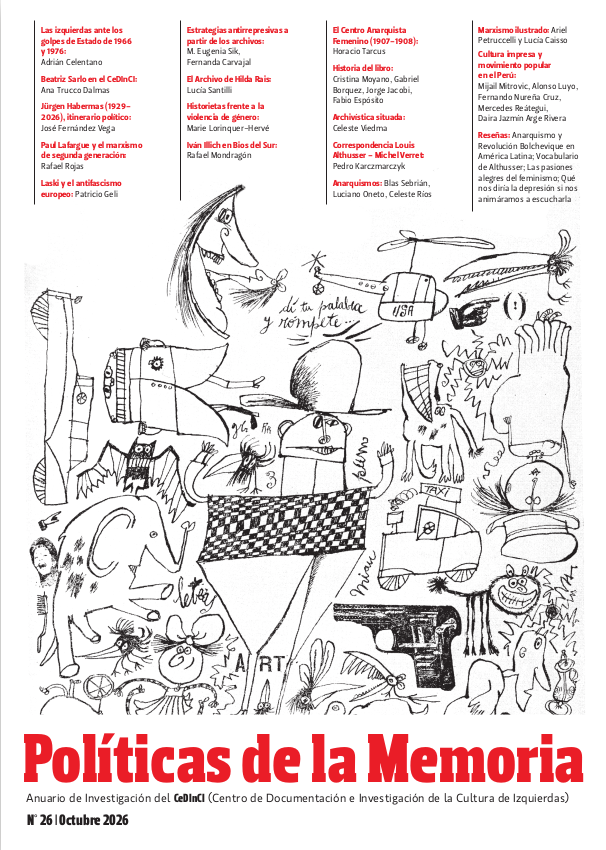
Whoever sets out one day to write the biography of Beatriz Sarlo will have to face many crossroads, many enigmas. None, however, as subtly intriguing as the geography of her farewell: her wake at the CeDInCI, an archive devoted to preserving the memory of the left, the avant-gardes, the revolutionary, emancipatory, and contestatory movements that imagined other possible futures.
There is an image there whose meaning deserves to be interrogated. Sarlo, who made criticism a way of thinking about the defeats, illusions, and mutations of the Argentine left, ended up being mourned in a place dedicated precisely to conserving their traces. As if her final destination had been an archive of the political promises of the twentieth century: the memory of what sought to transform the world, of what could have been and, many times, was not. And perhaps there is no more "Sarlean" setting for such a farewell: Sarlo's final scene unfolded among the material remains of the utopias she spent a good part of her life reading, interrogating, and debating.
Was Beatriz Sarlo a left-wing intellectual? Without doubt she was for much of her life. But perhaps there is a less imprecise way to put it: the left was the great political and cultural tradition on which Sarlo thought, wrote, debated, and measured herself throughout her intellectual trajectory. No other tradition interpellated her gaze with such force or demanded so much from her generous and incisive pen. It was within those coordinates that Sarlo built her interpretation of Argentine history and mass culture, of Peronism and the liberal tradition. And it was also from there that she fully entered the media circuit, constructing a journalistic notoriety she cultivated with pride, but without making that exposure a renunciation of the intellectual rigour that had always defined her public intervention.
The enigma, then, seems to dissolve and the scene begins to find its own logic. That Sarlo should have been mourned there is not surprising, and even seems inevitable: there is a deep affinity between her intellectual trajectory and that place, which ended up being also the setting of her final farewell. Few figures embodied as she did the ceaseless exercise of criticism, self-reflection, and intellectual conversation — that spirit inseparable from left-wing cultures that the CeDInCI not only preserves in its documents and libraries but seeks to prolong in the present. And it can do so, in large part, because it has built a singular form of institutional existence: independent, partially self-managed, and sustained by the contributions of its members, beyond the contingencies of state power and the political sign of successive governments. That autonomy is not an administrative detail but a condition of possibility for keeping a critical tradition alive without becoming subordinated to the needs, silences, or conveniences of each era. And it is precisely that affinity that makes the scene all the more intense: not an enigma to be solved, but an image laden with meanings that perhaps need not be deciphered, only mentioned, evoked, pointed to.
But let us return to the scene of her wake and to another of the questions that still resonate within it: why was it held at the CeDInCI and not at the Biblioteca Nacional? Why not at the Facultad de Filosofía y Letras, where for so many years Beatriz taught her courses in Argentine Literature, becoming one of that Faculty's most important professors? Why not lay her remains in state at the Legislatura de la Ciudad de Buenos Aires, given that Sarlo was an indisputable figure of Buenos Aires culture? The answer is not exhausted by personal closeness or circumstantial choice. Between Sarlo's trajectory and the CeDInCI there exists a concrete intellectual genealogy, a continuity made of shared problems, readings, and methods. From Punto de Vista and the Centro de Historia Intelectual at the Universidad Nacional de Quilmes to the work subsequently developed by the CeDInCI, a common constellation of concerns can be traced. Studies on reception, the sociology of literature, the essay, the history of the book, left-wing cultures, and the circulation of ideas still bear the mark of questions that Sarlo contributed decisively to installing in the Argentine intellectual field. The CeDInCI took up and extended much of that tradition — not as an immobile inheritance but as a living programme of research and criticism. For that reason, to mourn her among books, magazines, archives, and papers was not an arbitrary or merely symbolic gesture, nor a melancholy or aesthetic insistence on romanticization: it was also the recognition of an intellectual community that continues to think with some of the tools she helped to build.
That final scene of Beatriz's contains another image, perhaps even more eloquent: a few months after mourning her remains there, the CeDInCI also received her books and papers. If Sarlo left little clarity about what was to be done with her material legacy — her apartment, opening a long affair involving a legal husband and an upstart doorman — she was unambiguous about the destination of her library and personal archives. Before dying, she had expressed her wish that her library and personal archive be placed under the custody of the CeDInCI. Her friends fulfilled that wish: around four thousand volumes, together with letters, photographs, drafts, clippings, interviews, and research notes, were transferred from her study on Talcahuano Street to the archive on Rodríguez Peña. There they are being ordered, catalogued, and, finally, made available to all who may wish to consult them.
Perhaps there another meaning can be found for that initial scene. Sarlo was not only mourned in an archive. She was mourned in the place to which she had decided to entrust a decisive part of what would survive her death. The CeDInCI became the space destined to receive what could still go on speaking for her. First her remains; then her traces. And between the two there appears a singular form of inheritance: not the private transmission of a property, but the decision to transform an intellectual life into common patrimony.
A library and a personal archive do not preserve only books and documents: they conserve, always incompletely, the architecture of a life. They are, without meaning to be, the pieces of an autobiography. And Sarlo decided that this autobiographical architecture would rest in an institution devoted precisely to making private papers into public memory. For the CeDInCI, receiving that inheritance means something more than the incorporation of an extraordinary collection. It functions, in a sense, as institutional consecration: proof that this archive — born to rescue scattered papers, forgotten magazines, and left-wing memories — is the right place to receive and preserve one of Argentina's great intellectual legacies of the twentieth century. Sarlo chose the CeDInCI and, in choosing it, also said something about the CeDInCI.
But Beatriz never made condescension a virtue. Why then should we grant it to her final scene? Let us be honest and acknowledge what her death and our mourning push us to think. To mourn her at the CeDInCI suggests, from an ultra-pessimistic vantage point, an unsettling reading: that of a left-wing archive at risk of coming to resemble more and more a cemetery of ideas. Not because what it preserves has lost value, but because much of the political, intellectual, and cultural tradition gathered there seems to have been confined to the territory of memory. The archive, conceived to rescue from oblivion the traces of those who imagined other possible orders, might then be read as the mausoleum of our twentieth century: the place where its great emancipatory languages rest, its controversies, its defeats, and also a confidence in the future that today seems far harder to sustain. But what seems threatened is not only a set of ideas, but the circuit of criticism itself: attentive reading, interpretation, the freedom to dissent, the capacity to revise one's own certainties, the empathy required to understand what seems alien to us, and debate as a form of constructing thought. Sarlo was, perhaps more than almost any figure of her generation, a full expression of that circuit: to read, to interpret, to debate, to return to what had been thought, and to begin again.
All the same, Beatriz's physical disappearance consolidates other fears, when observed from the present: while the digital revolution radically alters our relationship with reading and memory, paper loses its centrality and libraries seem to belong to a retreating world; the new rights advance on a global scale, contesting not only many of the political and cultural certainties that structured the twentieth century, but also the intellectual procedures that made it possible to question them. In an era that rewards speed over reading, affirmation over doubt, and provocation over argument, criticism too seems to want to be buried. At that crossroads, to mourn Sarlo among books, magazines, pamphlets, and documents of the left could seem the perfect image of a double mourning: not only the farewell to one of Argentina's great intellectuals, but also to an era in which it was still believed that thinking meant pausing, debating, interpreting, and that ideas could organize the future. The question, then, is whether we stand before a cemetery or before a reserve: whether those papers are solely the remains of a finished world or the materials with which, someday, another might be imagined.
But archives, though they may resemble cemeteries in their relationship with the past, are something very different. It may even be, in fact, that exactly the opposite is the case. An archive does not bury or turn the traces of the past to ashes: it keeps them available. It preserves what the present might prefer to regard as definitively defeated. In that sense the archive is also a certainty: the certainty that political defeats do not render ideas useless, and that even when an era insists on closing them down, there will always be a need for a place where they can be found and revisited again — perhaps recovered. In that certainty Sarlo's final scene is inscribed: her farewell and her departure, but also her life, her archive, and her library will now be available to all who, someday, may wish to rescue them. May it be so.

This work is licensed under a Creative Commons Attribution-NonCommercial-NoDerivatives 4.0 International License.